Why The Cross?

If you find this helpful, consider subscribing. And if you’re already a subscriber, thank you. Whether you’re here often or just passing through, a simple like or restack helps this reach someone who may be quietly searching.
When someone asks, “If God is truly merciful, why couldn’t He simply forgive? Why did Jesus have to die?” they are not asking a foolish or hostile question. They are asking a question that makes sense within a legal imagination of salvation. If sin is primarily a matter of guilt, liability, and penalty, then forgiveness should simply be a matter of God choosing not to enforce the law. In that framework, the Cross can look like an unnecessary complication—or worse, a divine requirement imposed on God Himself.
That question deserves to be answered honestly, not dismissed. And the answer is not that God was constrained by some higher justice, nor that forgiveness was impossible without blood. The deeper answer is that the question itself already assumes a particular model of what sin is and what salvation must therefore be. And that model is not the one the apostles or the Eastern Church Fathers begin with.
To see this clearly, we need to step back and ask a more basic question: What is the actual problem salvation is meant to address? Is it legal liability, or is it something more fundamental—something ontological, something tied to what it means to be human at all?
This is where the witness of Gregory of Nyssa becomes especially helpful, not because he invents a new theory, but because he articulates with clarity what the Church had already received from Scripture.
In On the Making of Man, Saint Gregory does not begin with guilt, punishment, or legal standing. He begins with creation. Humanity, he says, was created in the image of God, not merely as a moral resemblance, but as a living capacity for communion with divine life. The image is dynamic. It is ordered toward likeness. Humanity was created to grow into God, to live in freedom, incorruption, and communion.
Sin, then, is not first a crime in a courtroom. Sin is a deformation. It is a distortion of human nature. It fractures the harmony of the soul, disorients desire, darkens perception, and—most decisively—introduces death. For Gregory, death is not an externally imposed penalty; it is the consequence of separation from the source of life. Turn away from Life, and corruption follows.
Once this is seen, the original question begins to change. If the problem is death, corruption, and disintegration, then forgiveness alone cannot solve it. Forgiveness does not heal a wound. Forgiveness does not resurrect a corpse. Forgiveness does not restore a nature enslaved to decay. To “just forgive” would leave humanity exactly where it is—still dying, still divided, still unable to live the life for which it was created.
This is why Saint Gregory does not say that God needed the Cross in order to forgive. He says that humanity needed God to enter death in order to be healed.
That healing begins with the Incarnation. Salvation does not start at the Cross; it starts when the Son of God assumes human nature in its fallen condition. Not an ideal humanity, but the humanity that hungers, suffers, ages, and dies. Gregory is insistent: what is not assumed is not healed. By uniting divine life to mortal human nature, Christ begins restoring humanity from the inside.
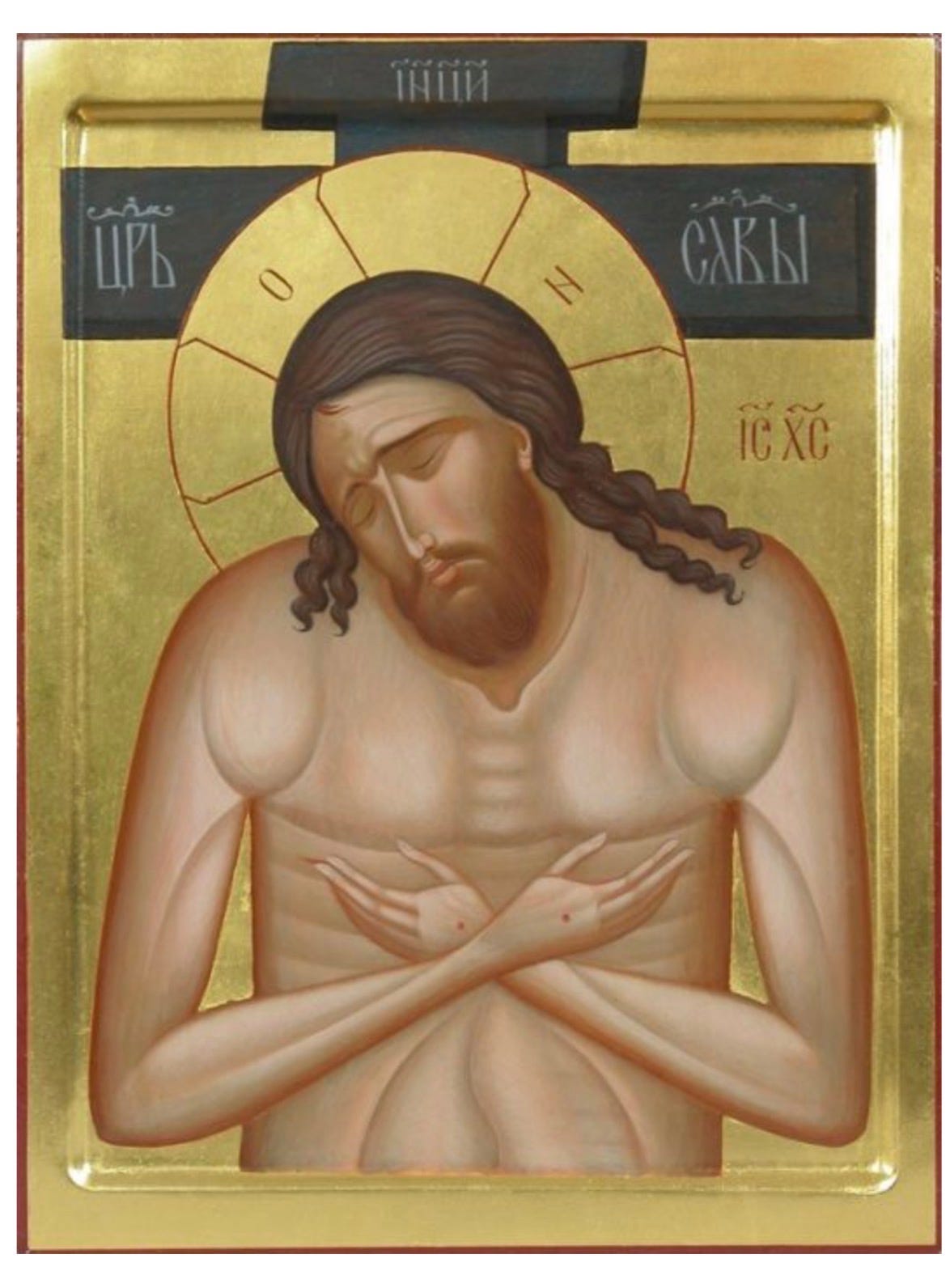
The Cross, then, is not a legal transaction between the Father and the Son. It is the place where death encounters Life incarnate. Death does what death always does—it consumes. But this time it consumes the One in whom divine life dwells bodily. Gregory uses vivid imagery here, describing death taking the “bait” of Christ’s humanity and being undone by the divinity hidden within. This is not payment. It is conquest.
Christ does not die so that God can forgive. He dies so that death itself can be destroyed.
The Resurrection makes this unmistakable. A human being passes through death and emerges incorruptible. The tomb is empty not because a debt has been settled, but because death has lost its hold. Christ does not escape death; He exhausts it. A new form of human life now exists.
This way of speaking is not a later theological development. It is how the New Testament itself frames salvation.
Saint Paul writes:
“And you were dead in your trespasses and sins” (Eph 2:1, LSB).
Not indebted. Not merely guilty. Dead. And then:
“But God, being rich in mercy… made us alive together with Christ” (Eph 2:4–5, LSB).
The movement is from death to life, not from guilt to acquittal.
In Romans, Paul again frames the problem this way:
“Through one man sin entered into the world, and death through sin, and so death spread to all men” (Rom 5:12, LSB).
Death spreads. And Christ enters precisely there, not simply to alter a verdict, but to inaugurate a new humanity:
“So then as through one transgression there resulted condemnation to all men, even so through one act of righteousness there resulted justification of life to all men” (Rom 5:18, LSB).
Justification of life. Life is the content of salvation.
Hebrews states this even more directly:
“Since the children share in flesh and blood, He Himself likewise also partook of the same, that through death He might render powerless him who had the power of death… and might free those who through fear of death were subject to slavery all their lives” (Heb 2:14–15, LSB).
The enemy is death. The condition is slavery. The result is liberation.
From this perspective, the original question—“Why couldn’t God just forgive?”—begins to dissolve. Forgive what, exactly? A nature still enslaved? A humanity still decaying? Mercy does not ignore reality. Mercy enters it, bears it, and transforms it.
Union with Christ, then, is not metaphorical. It is participation. As Saint Paul says:
“We have been buried with Him through baptism into death, so that as Christ was raised from the dead… so we too might walk in newness of life” (Rom 6:4, LSB).
Newness of life. Recreation. Restoration.
Saint Gregory’s vision does not diminish forgiveness. It explains it. Forgiveness flows from healing; it does not replace it. God does not pretend that sin has not damaged us. He heals the damage. He does not overlook death. He destroys it. He does not change His disposition toward humanity. He recreates humanity itself.
This is why the Cross is not an obstacle to mercy but its deepest expression. God does not remain distant and simply declare us forgiven. He comes near. He enters our condition. He carries human nature through death into life. And then He invites us to share in that life, not as spectators, but as participants.
Once this is seen, the question is no longer whether God could simply forgive. The question becomes why anyone would want a forgiveness that leaves death untouched, humanity unhealed, and creation unreconciled—when the Gospel offers something far greater: resurrection, communion, and life in Christ.
This is outstanding, dear Father Deacon. Thank you for saying it so clearly and pastorally.
Thank you.